
Can Any Story Justify War?
Civilizational narratives, ethics, and international law
30 April 2026
Farahnaz Karim
On 20 January 2025, President Trump began his second mandate. In November 2025, the National Security Strategy of the United States of America was published. It is enlightening to revisit how this pivotal document framed Iran and the region. In his letter prefacing the strategy, President Trump narrates some of his self-proclaimed accomplishments earlier that year, referring to the June 2025 attack on Iran:
In Operation Midnight Hammer, we obliterated Iran's nuclear enrichment capacity.
I declared the drug cartels and savage foreign gangs operating in our region as Foreign Terrorist Organizations. And over the course of just eight months, we settled eight raging conflicts - including between Cambodia and Thailand, Kosovo and Serbia, the DRC and Rwanda, Pakistan and India, Israel and Iran, Egypt and Ethiopia, Armenia and Azerbaijan, and ending the war in Gaza with all living hostages returned to their families.
America is strong and respected again - and because of that, we are making peace all over the world.
On the Middle East, the strategy document states:
Conflict remains the Middle East’s most troublesome dynamic, but there is today less to this problem than headlines might lead one to believe. Iran - the region’s chief destabilizing force - has been greatly weakened by Israeli actions since October 7, 2023, and President Trump’s June 2025 Operation Midnight Hammer, [...] significantly degraded Iran’s nuclear program. […]
As this administration rescinds or eases restrictive energy policies and American energy production ramps up, America’s historic reason for focusing on the Middle East will recede. Instead, the region will increasingly become a source and destination of international investment, and in industries well beyond oil and gas - including nuclear energy, AI, and defense technologies. […]
But the days in which the Middle East dominated American foreign policy in both long-term planning and day-to-day execution are thankfully over - not because the Middle East no longer matters, but because it is no longer the constant irritant, and potential source of imminent catastrophe, that it once was.
And yet, a couple of months later, the United States and Israel initiated Operation Epic Fury, a major combat operation against Iran in the final hours of February 28, 2026 - during Ramadan, no less, and ahead of the millenarian celebration of the Persian New Year. The justification for the war was communicated through a televised address and via the President’s Truth Social account. President Trump announced that ‘the United States military began major combat operations in Iran’ presenting four linked objectives: to ‘obliterate Iran’s ballistic missile arsenal and production capability’, to ‘annihilate its navy’, to ‘sever its support for terrorist proxies’, and to ‘ensure the world’s leading state sponsor of terrorism never acquires a nuclear weapon’. Over the next few weeks, ‘Total and Complete Regime Change [sic]’ and decimation of Iran’s civilian infrastructure were added as ancillary objectives, when suitable. [i] Prime Minister Benjamin Netanyahu, speaking on the day of the attack from Tel Aviv, stated that Israel was acting to remove an ‘existential threat’ and urged the Iranian people to ‘cast off the yoke of tyranny’.
It is important to recall that the domestic context of Iran’s resurgence as a US-Israeli target was preceded by the dismissal of a strata of US civil servants and foreign service officers, some 1,300 State Department officials, including in the Bureau of Near Eastern Affairs where the dedicated Iran office was merged with the Iraq office. In the early months of 2025, reminiscent of his reality TV role in The Apprentice, President Trump ‘fired’ four-star general Charles Q. Brown Jr., the second Black officer to hold the title of Chairman of the Joint Chiefs of Staff, Admiral Lisa Franchetti, the first woman to lead the Navy, the vice chief of the Air Force, and the top lawyers for the Army, Navy, and Air Force, to name a few. More specifically over Iran, the Head of the US Defence Intelligence Agency, Lt Gen Jeffery Kruse, the chief of US Naval reserves and the commander of Naval Special Warfare Command, and General Randy George, who was just over halfway through his tenure as Army chief of staff, were also discharged along with other senior officials. More recently, Navy Secretary John Phelan was asked to leave ‘effective immediately’ amid a naval blockade in the Strait of Hormuz. A pattern of ideological or subject-matter differences with the President and/or his Secretary of War, Peter Hegseth, appears to shorten service terms of the highest echelons of strategy and command, thus mislaying precious domain and regional expertise, along with collective intelligence.
Herein lies the conundrum.
If the US National Security Strategy, presumably built on input from its stellar intelligence and defence community, did not frame Iran and the Middle East as an imminent threat or danger, how did we end up here?
Can any story justify war?
Are there narrative, ethical, and legal boundaries that constrain state behaviour to prevent the normalization of international dis-order? This piece is centred around this timely interrogation.
The Power of Historical Storytelling
To understand the ‘narrative triggers’ of the 2026 war with Iran, it is useful to examine the perspectives of the three protagonists: the US, Israel, and Iran.
The US Narrative Arc
The story used by President Trump to justify and strengthen the rationale for Operation Epic Fury is constructed over a four-decade narrative arc (see February 28, 2026 speech and April 1, 2026 address). It begins with a reminder of chants of ‘Death to America’ and ‘Death to Israel’ during the 1979 hostage crisis (which lasted for 444 days; and was formally adjudicated by the Internal Court of Justice in 1980 in favour of the United States), continues through the 1983 Beirut barracks bombing, the attack on the USS Cole in 2000, attacks on US forces in Iraq and through Iran’s proxies in the region, the 2015 JCPOA (i.e. the nuclear deal with Iran signed during Obama’s second term), the 2018 unilateral US withdrawal from this agreement under President Trump’s first term, the ‘maximum pressure’ campaign, the January 2020 assassination of Major General Qasem Soleimani, the October 7, 2023 Hamas attacks on Israel, and the June 2025 Operation Midnight Hammer.
Within this 47-year historical timeline, Iran is framed as a dangerous state, a de facto non-sovereign state (a fact confirmed by the boastful decimation of its state’s leadership in the early days of Operation Epic Fury), and a civilisational adversary.
Extending the narrative arc into millenarian space, on April 7, 2026, to the dismay of human rights scholars, President Trump announced: ‘A whole civilization will die tonight, never to be brought back again’. Civilizational discourses have been vehemently debated in International Relations (IR), particularly following Samuel Huntington’s polemic article The Clash of Civilizations? published in Foreign Affairs (1992), followed by his book The Clash of Civilizations and the Remaking of World Order (1996). Huntington argues that the post-Cold War era would be divided into cultural blocs, with religion as the core identity. Thirty years later, his ideas are resurfacing in full force. The US Secretary of War, Peter Hegseth, posits in The Battle for the American Mind (2022), that the survival of Western civilization depends on the reintroduction of Christianity to American schooling – but a particular flavour of Christianity. Hegseth believes he is the instrument of God in pursuing violence against his enemies in Iran — an assertion Pope Leo XIV has refuted. He bears the words 'Deus Vult' ('God wills it'), a phrase from the 1095 Crusade and a badge of his evangelical predilection, tattooed on his right biceps. Biblical constructs likewise feature in Israel's justifications.
The Long-standing Israeli Argument
The Israeli argument for the 2026 war with Iran is the culmination of a long-standing personal project. Prime Minister Benjamin Netanyahu warned of an imminent Iranian nuclear weapon for nearly forty years. In 1992, as a Likud member, he told the Knesset that Iran would be ‘autonomous in its ability to develop and produce a nuclear bomb’ within three to five years. In 2012, at the UN General Assembly, he displayed a cartoon bomb to argue that Iran would cross a red line ‘by next spring, at most by next summer’.
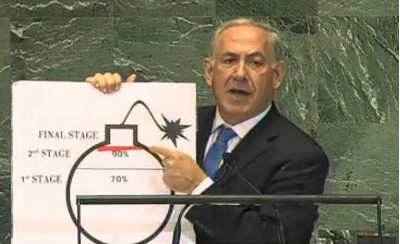
Prime Minister Benjamin Netanyahu's Iran nuclear diagram, presented at the UN General Assembly in September 2012.
Source: 27 September 2012, Times of Israel
In 2018, his ‘Iran Lied’ presentation was credited with influencing President Trump’s JCPOA withdrawal. In his February 28, 2026 war address, the same argument was reiterated: that Iran was ‘very close’ to a weapon and could produce ‘hundreds of missiles per day’, thus further solidifying the existential threat rationale and justifying Israel’s action as defensive.
This long-standing and recurrent ‘existential threat’ argument was compounded in 2026 with a delayed revenge argument for the Hamas attacks of October 7, 2023.
Israeli Defence Forces (IDF) statements in early March asserted that Israel ‘will not forget’ Iran’s sponsorship of Hamas, and Netanyahu spoke of ‘accounting for every Israeli who died on October 7th, from every hand that enabled it’. This extension serves to weave together a series of post-October 7th actions (i.e. Gaza 2023–present, Lebanon 2024, Syria 2024, Yemen 2024–2025, Iran 2025–2026, Lebanon 2025-2026) into a strategic singular campaign, thereby capitalising on the domestic legitimacy generated by the Hamas attacks to build a unified endorsement for the Iran or Iran-related attacks.
Similarly to the United States, Prime Minister Benjamin Netanyahu draws an overarching millenarian, civilizational arc. His 2012 address to the UN General Assembly began with:
Three thousand years ago, King David reigned over the Jewish state in our eternal capital, Jerusalem’ […] The Jewish people have come home. We will never be uprooted again’ […] In Israel, we walk the same paths tread by our patriarchs Abraham, Isaac and Jacob. But we blaze new trails in science, technology, medicine, agriculture. In Israel, the past and the future find common ground. Unfortunately, that is not the case in many other countries. For today, a great battle is being waged between the modern and the medieval.
The Operation Epic Fury address begins with parables of the Rising Lion and the Roaring Lion, Israel’s respective names for the Iran operations of June 2025 and February 2026. The Lion represents Israel, but, at times, it also symbolizes Iran’s pre-revolutionary era, in reference to the Lion and Sun flag associated with the Pahlavi dynasty. The justification for the attacks also includes stories of Amalek (the symbol of Israel’s archetypical enemy) found in Deuteronomy (the Torah’s last book), to cast Iran as a millennial enemy. Since publication, Netanyahu’s February 28, 2026, address has been redacted with significant Biblical passages deleted in its English version.
Iran’s Vast Collective Memory
Iran’s legitimation strategy rests on a historical narrative dating back to 1953, the year the United States orchestrated the coup.
Iran’s UN Mission stated that 1953 marked ‘the inception of relentless American meddling in Iran’s internal affairs’ and that the CIA’s partial acknowledgement of that coup has ‘never translated into compensatory action’.
The 1953 coup d’état, a CIA-led operation, supported by MI6, removed the democratically elected Mossadegh government, reinstalled the Shah, and, with US, and some French support, organised SAVAK (an acronym for Sâzmân-e Ettelâ'ât Va Amniyyat-e Kešvar), the Bureau of Intelligence and Security of the State. The ‘American meddling’ was consequential. From the standpoint of Iranian monarchists, the West's betrayal of the Shah was only the beginning. The United States went on to arm Iraq throughout the 1980–1988 Iran-Iraq war, even during its chemical weapons phase, before shooting down Iran Air Flight 655 in 1988. In the years that followed, Washington supported Israeli assassinations of Iranian scientists from the 2010s onward, then unilaterally withdrew from the JCPOA in May 2018 — despite Iran's compliance, certified by the IAEA. The escalation continued with the assassination of Major General Soleimani in January 2020 and culminated in two military operations: first Operation Midnight Hammer against Iranian nuclear infrastructure in June 2025, then Operation Epic Fury, launched in the midst of promising nuclear negotiations. In essence, the Iranian narrative is centred on a seven-decade pattern of aggression and betrayal by the United States, in particular. This, in turn, justifies the regime’s structural distrust towards the US (and Israel) – and indifference to leadership changes, and explains Iran’s refusal to accept terms that would annihilate or curtail its sovereign defence and deterrence capability permanently.
As in the US and Israel, divine imagery also plays a key role in the civilizational storyline of Iran. Iran’s equivalent to Israel’s Amalek story is the Battle of Karbala. The narrative of Imam Hussein’s unjust and heroic slaying [ii] is omnipresent in political and popular culture in Iran. The archetype of the martyr - the shahid who faces death to defy tyranny, choosing good (and God) over the evil embodied by the Umayyad ruler Yazid -serves a dual purpose: to underscore a ceaseless victimisation and the heroic appeal of martyrdom in the face of any ‘Yazid’, a trans-historical enemy, such as Saddam Hussein or The Great Satan, America. In 2020, following the targeted assassination by US forces of General Soleimani [iii] Ali Khameini posted an image on his website of the General in the arms of Iman Hussein, united as martyrs.

The Karbala Narrative: Imam Hussein holds fellow martyr General Soleimani
Source: Tehran Times, 2020 from website of Ali Khamenei
But Iran, a 5,000-year-old civilization, also draws from a longer pre-Islamic civilizational identity. At the centre of this pre-Islamic Iranian narrative lies Cyrus the Great, the founder of the Persian empire – the Achaemenid King of Kings (Shahanshah), whose empire ruled Persia (and most of the Middle East) for over 200 years, from 559 BCE to 330 BCE, until conquered by Alexander the Great. Animated by a desire to restore the civilisational grandeur of Iran whilst adopting certain Western ideas of progress around technology and science, the Shah, in 1971, convened a truly epic ceremony. He invited a delegation of world leaders and celebrities to honour his claim to a 2,500-year monarchical lineage back to Cyrus the Great. His vision was to build a 'Great Civilisation' (tamaddun-i bozorg).
Although the starting point of the three narrative arcs differs - 1979 for the US, 1992 for Israel, and 1953 for Iran - all three protagonists draw a straight line from Biblical times and Islam’s succession battle to justify today’s attacks.
If any war can be narratively constructed to span millennia, are there any ethical parameters left to judge a war's justification objectively?
The Ethics of War
Several ethical frameworks can be used depending on one’s reasoning or theoretical underpinning to assess a war, namely, categorical, consequentialist, realist frameworks, and Just War Theory.
Some religious traditions, pacifist movements, and non-violence frameworks reject war outright on categorical grounds: states may not initiate violence against other states when the threat is speculative. Moreover, regime change by force is inconsistent with the dignity and self-determination of peoples. The 2026 Iran war does not, therefore, meet the categorical viewpoint’s criteria.
Consequentialist frameworks weigh a war's likely consequences through cost-benefit analysis: civilian casualties, economic disruption, precedent effects (e.g. Iraq, Syria, Libya, Afghanistan). In the case of the 2026 Iran war, the balance is weighted toward the real costs of the war since the avoided harm (Iran’s nuclear weapons’ use) is speculative while the inflicted harm, i.e. civilian deaths, regional war, oil disruption, financials costs, is real. As such, for consequentialists, this war is not justified.
Realist ethical frameworks see states as moral agents. For them, states need to exercise foresight and wisdom, and must ask: will the 2026 war strengthen or weaken US and Israeli security over a 10–20-year horizon? From their standpoint, the war is detrimental to long-term interests as it risks militarizing the Gulf and eroding the counter-proliferation regime.
Just War Theory, which covers the lifecycle of armed conflict, is arguably the central ethical framework to assess wars. It encompasses jus ad bellum, right to war, as well as jus in bello, right in war (i.e. humanitarian law), and jus post bellum, which focuses on justice, reconstruction, and obligations after conflict.
Jus ad bellum, centred on a set of six conditions, is particularly suited to review and assess the ethical basis of the start of the 2026 Iran war.
1. Just Cause
Is there a real reason for war?
Just cause is the canonical principle which justifies war as self-defence against an armed attack. Whilst many shifting narratives compete to rationalize the 2026 attacks, the predominant one centres on the prevention of Iran’s ability to build, acquire, or use a nuclear weapon. This is a preventive cause rather than a pre-emptive cause. There was no ongoing Iranian armed attack on either Israel or the United States at the moment of the 28 February strikes. In fact, the US had unilaterally withdrawn from the JCPOA process in 2018, reportedly ‘obliterated Iran’s nuclear enrichment capacity’ in June 2025 and attacked Iran again in February 2026 whilst satisfactory negotiations were underway around the nuclear issue. The case for just cause is therefore weak.
2. Legitimate authority
Was the decision made by the authorized body or leader of a state?
In the case of the United States, the authority is constitutionally shared between President and Congress – so far Congress has not declared war. In the Israeli case, the Security Cabinet approved the operation. In Iran’s case, the Supreme National Security Council approved retaliation under the authority vested in the new Interim Leadership Council. Legitimate authority may require further domestic consent, particularly in democracies, either though legislative action or an electoral process.
3. Right intention
Is the goal to bring peace?
Right intention is the requirement that the stated cause is the actual cause, and that war is not pursued for reasons of vengeance, expansion, or cruelty. The US language around civilizational annihilation, return to the ‘Stone Age’, and other threats and expletives posted by the President Trump, as well as revenge-framing language from Israel, complicates the case for right intention.
4. Last resort
Have all other methods failed?
Last resort requires that peaceful means must have been exhausted. On 27 February, Oman’s Foreign Minister publicly stated that a ‘breakthrough’ in nuclear negotiations had been reached and that peace was ‘within reach’. The 28 February operation began less than twenty-four hours later. Based on the evidence, this clearly did not constitute a last-resort scenario.
5. Proportionality
Will war cause more harm than good overall?
At the ad bellum stage, proportionality asks whether the expected overall good of the war is greater than the expected overall evil. This is where the nebulous, ever-shifting motives for the war prevent rational assessment. A full-scale, regime-change war - with its continuing regional consequences, civilian casualties on all sides, disruption of global energy markets, and precedent-setting weakening of the UN Charter - is difficult to reconcile with a stated aim of counter-proliferation that was, literally, already underway. The case for proportionality appears tenuous.
6. Likelihood of success
Are the aims achievable – or will they lead to a status quo or worst?
On the nuclear front, the June 2025 operation’s results (i.e. obliteration of Iran’s nuclear capacity) have been disputed and the whereabouts of a stockpile of some 200 kg of enriched uranium are unknown or only partially known. Despite the decimation of Iran’s leadership, regime change has not occurred, and Mojtaba Khamenei’s fragile succession, has, if anything, consolidated the revolutionary regime and its institutions. In the absence of clear goals and metrics, and amid a constant flux of cyclothymic official statements, the likelihood of success seems low, given that success itself was undefined, re-interpreted, or unrealistic from the start.
In sum, by the standards of jus ad bellum and other ethical frameworks, Operation Epic Fury is morally unjustified.
Jus in bello, right in war, imposes two main tests on belligerent conduct: discrimination (i.e. combatants and objects only, not civilians) and proportionality (i.e. incidental civilian harm must not be excessive in relation to concrete and direct military advantage). Attacks on civilian targets such as schools, hospitals, civilian infrastructure and cultural heritage sites in Iran evidence US violations of humanitarian law, just as Israel’s targeting of Lebanon does. The sensitivity of potential attacks on nuclear sites is carefully monitored given the risk of radiological consequences on civilians. Finally, Iran’s retaliation on third states, i.e. Gulf states’ territories, people, civilian infrastructure, and commercial shipping, raises discrimination and proportionality issues symmetrical to those raised by the war’s initiators.
Jus in bello or the humanitarian conduct of all three parties, including Iran’s retaliation on Gulf states - particularly those not formally aligned with Israel, violates humanitarian law.
International Law and Realpolitik
Given the subjective narratives at play and the nuanced ethical dimensions of the US-Israeli attacks on Iran, can international law provide further clarity? Is the February 28, 2026, war lawful?
The United Nations Charter
Based on the extract below of the UN Charter’s article 2(4), which prohibits the use of force against another state, the war is illegal.
Article 2, United Nations (UN) Charter
The Organization and its Members, in pursuit of the Purposes stated in Article 1, shall act in accordance with the following Principles.
The Organization is based on the principle of the sovereign equality of all its Members.
All Members, in order to ensure to all of them the rights and benefits resulting from membership, shall fulfill in good faith the obligations assumed by them in accordance with the present Charter.
All Members shall settle their international disputes by peaceful means in such a manner that international peace and security, and justice, are not endangered.
All Members shall refrain in their international relations from the threat or use of force against the territorial integrity or political independence of any state, or in any other manner inconsistent with the Purposes of the United Nations.
There are only two recognized exceptions to Article 2(4): self-defence under Article 51 against an actual or imminent armed attack, or authorization by the Security Council.
Article 51, UN Charter
Nothing in the present Charter shall impair the inherent right of individual or collective self-defence if an armed attack occurs against a Member of the United Nations, until the Security Council has taken measures necessary to maintain international peace and security. Measures taken by Members in the exercise of this right of self-defence shall be immediately reported to the Security Council and shall not in any way affect the authority and responsibility of the Security Council under the present Charter to take at any time such action as it deems necessary in order to maintain or restore international peace and security.
Article 51 Applied to the US and Israel
There is consensus among some 100 international law professors, and law associations, including in the US, that neither exception applies to this war. Iran did not attack Israel or the US first, the Security Council never authorized force, and the ‘imminent threat’ argument (i.e. Iran’s nuclear program) does not meet the traditional Caroline-test centred on imminence. The Caroline test, articulated by US Secretary of State Daniel Webster in correspondence with the British government in 1841–1842, restricts the right of self-defence to cases showing a necessity of self-defence that is ‘instant, overwhelming, leaving no choice of means, and no moment of deliberation’ and requires that any action be proportional. The Pentagon’s own 1 March 2026 briefing to congressional staff conceded that Iran had no intent to strike US assets absent Israeli action.
US and Israel’s Self-defence Claim
The US State Department's legal adviser, and some scholars, counter-argued the February 2026 operations were not a new resort to force but a continuation of an existing armed conflict that began in June 2025. As such, the relevant law applicable to Operation Epic Fury is jus in bello (i.e conduct in war) rather than jus ad bellum (i.e. legality of entering into war). Based on that framing, no new self-defence justification is required. Moreover, they argue that Iran's nuclear progress, support for armed proxies, and prior missile exchanges constitute a cumulative armed-attack pattern that grounds self-defence.
Iran’s Article 51 Claim
Iran’s Article 51 claim is legally more straightforward, but not unproblematic. As the state that suffered an armed attack on its territory, Iran’s right to respond in self-defence is not contested. What is contested is the scope. Under customary limits, the response must be necessary (aimed at repelling the attack) and proportionate (limited to what is necessary). Iranian strikes on Israeli territory and on US bases directly supporting the operation fall inside the standard self-defence scope. However, strikes on commercial shipping, embassy compounds not belonging to belligerents, and territory of non-belligerent third states test the limits of Article 51 and raise the spectre of counter-retaliation measures exceeding the self-defence argument.
The Enforcement Problem
In International Relations (IR) theory we learn as first-year students about realism, power, and anarchy. ‘Anarchy’ encapsulates the recognition that at the global level, there is no supra-state authoritative body, no world government. Consequently, the United Nations is only as performant as the states that govern and finance it. International law, even when unambiguous on UN Charter or human rights violations, is structurally constrained by Realpolitik, by the reality of governance at the Security Council level.
Hence, despite the unlawful nature of the 2026 war on Iran, the Security Council, as a body, did not condemn the attacks.
A draft resolution co-sponsored by Russia, China, and Pakistan calling for an immediate ceasefire and condemning the attacks on Iranian nuclear facilities, was defeated. Instead, Resolution 2817 (2026), was adopted on 11 March 2026 (13-0 votes, with Russia and China abstaining) [iv], condemning Iran's retaliatory strikes against neighbouring states. On 22 March, a non-binding General Assembly resolution was adopted (under the Uniting for Peace procedure) demanding an immediate halt to hostilities and recalling the Charter’s prohibition on the use of force.
In conclusion, this exploration of the narrative, ethical, and legal parametres that frame the 2026 Iran war uncovers fascinating insights. First, stories from the US, Israel, and Iran are powerful in cementing their domestic constituencies and creating a sanctioning environment for their actions, even when these stories draw a perfectly crafted fictional line across millennia. Civilizational and religious imaginary constructs offer citizens a powerful, emotional, liminal space enabling the expression or consolidation of state power. Stories can and do justify wars. In the words of Yuval Noah Harari [v]:
Human groups are defined more by the changes they undergo than by any continuity, but they nevertheless manage to create for themselves ancient identities thanks to their storytelling skills.
No matter what revolutions they experience, they can usually weave old and new into a single yarn.
Second, if narratives are inherently subjective, Just War Theory and other ethical frameworks provide more clarity to evaluate the moral basis for war. In this case there was none: the start of the war by the US and Israel is not justifiable on moral grounds. Moreover, all three parties failed to uphold an ethical standard in the conduct of war. Third, on the legal dimension, there is expert consensus that the 28 February initiation of war violated Article 2(4) of the UN Charter, yet the Security Council could not agree to adopt a resolution in this regard. The clarity of the legal diagnosis contrasts with the weakness of the enforcement architecture. This is neither new nor unique to this war. Limits on states are difficult to impose by states. Simply put, in the domain of ‘the maintenance of international peace and security’, there seems to be a principal-agent problem, perhaps by design.
[i] For instance, on April 5th, 2026, at 8.03 am, President Trump wrote on his social media platform: ‘Tuesday will be Power Plant Day, and Bridge Day, all wrapped up in one in Iran. There will be nothing like it!!! Open the Fuckin’ Strait, you crazy bastards, or you’ll be living in Hell – JUST WATCH! Praise be to Allah. President DONALD J. TRUMP’.
[ii] Ali’s two sons, Hassan and Hussein, were the grandsons of the Prophet Muhammad. Whilst Hassan abdicated power to Muawiyah I - the first ruler of the (Sunni) Umayyad dynasty, Hussein was seen as the valiant one. In 680 CE, accompanied by only 72 men, he attacked, but was defeated and slaughtered by Yazid I, the ruler of the Umayyad dynasty’s 4,000-strong army, in the plains of Karbala, in today’s Iraq. The celebration of Ashura, the martyrdom of Imam Hussein, is the seminal memory for Shiʿa. Every year, scenes of self-flagellation are enacted to experience the suffering of the beloved Imam and plays are enacted all over Iran (tazzīyahs) on the 10th day of Muharram, as well as another forty days later.
[iii] Qasem Soleimani was an Iranian military officer who served in the Islamic Revolutionary Guard Corps, from 1998 until his assassination in 2020 by US air strikes. He was the commander of the Quds Force, an IRGC division primarily responsible for extraterritorial and clandestine military operations.
[iv] The 15-member Council members who voted on this resolution are:
Voted in Favor (13): Bahrain, Colombia, Democratic Republic of Congo, Denmark, France, Greece, Latvia, Liberia, Pakistan, Panama, Somalia, United Kingdom, and the United States.
Abstentions (2): China and Russia
NB: In the UN Security Council, all 15 members have votes that are mathematically equal in the final tally, but the five permanent members (i.e. P5 - China, France, Russia, UK, US) hold veto power.
[v] Harari, Y. N. (2018). 21 Lessons for the 21st Century (1st ed.). Spiegel & Grau.