
Gulf (and other) Rivalries in Sudan and The Horn: The Danger of Proxy Wars and Moral Agnosticism
27 March 2026
Farahnaz Karim
In 1513, Niccolò Machiavelli wrote Il Principe (The Prince), a succinct hands-on manual on power, how to acquire it, and maintain it. The manuscript was dedicated to and written for Lorenzo di Medici, whose Florentine principality was threatened by foreign powers such as France, Spain, and the Holy Roman Empire.
In surveying different types of states or political systems, Machiavelli argued that hereditary principalities are easier to manage than new states. The prince simply needs to maintain respect for traditions and adapt to situations. He is only likely to lose power if challenged by an exceptional force, and even then, he could regain it - as people prefer stability. He writes:
Dico, adunque, che negli stati ereditarii e assuefatti al sangue del lore principe sono assai minori difficultà a manternerli che ne’ nuovi ; perché basta solo non preterire l’ordine de’ sua antenati, e di poi temporeggiare con gli accidenti; in modo che se tale principe è di ordinaria industria, sempre si manterrà nel suo stato, se non è una estraordinaria ed eccessiva forza che non lo privi ; e privato che ne fia, quantunque di sinistro abbi lo occupatore, lo riacquista.
Over 500 years later, The Prince remains remarkably modern and useful for understanding the morally agnostic, kaleidoscopic geopolitics of our time – and the monarchical advantage of domestic stability.
In particular, it helps to frame our understanding of foreign policy choices of princes today, notably, Crown Prince and Prime Minister Mohammed bin Salman Al Saud (MBS), heir apparent to the Kingdom of Saudi Arabia, and Sheikh Mohammed bin Zayed Al Nahyan (MBZ), ruler of Abu Dhabi and president of the United Arab Emirates (UAE).
The common source of their legitimacy rests indeed on tradition, on dynastic lineages grounded in respect for religion and culture, further legitimized by a remarkable ability to modernize and increase the standard of living of their citizens – building on geological luck and ambitious diversified development plans. But what happens when modern monarchs and their states become rivals in foreign lands, as they ‘adapt to situations’, as Machiavelli phrased it?
This question is particularly salient following the 28 February 2026 illegal attacks by Israel and the US on Iran and their direct repercussion on the stability of the Gulf. Missile and drone attacks on the UAE and Saudi Arabia’s infrastructure and US military bases, disruptions in the Strait of Hormuz, their loss of revenue around oil exports, trade and tourism, and the collapse of their security-cum-stability narrative, is likely to intensify their competition to rebuild. Beyond rebuilding, one can anticipate a re-assessment of their respective security alliances, foreign policy strategies, and a renewed attention to the Horn of Africa and the Strait of Bab-al-Mandab, another significant oil choking point.
The case study of Sudan, within the context of the Horn, provides timely, fascinating insights into the evolution of the foreign policy strategies of these two Gulf monarchies, Saudi and the UAE. As they emerge as global powers, do their princes, MBS and MBZ, hold the key to stability in their region?
Sudan’s Post-colonial Identity Search
On January 1st 1956, Sudan achieved independence from Britain and Egypt’s condominium - the year of the Suez Canal crisis and Nasser’s nationalist impetus. Sudan’s post-colonial history is marked by a recurrent, quasi-metronomic oscillation between attempts at establishing democratic institutions and recurrent coups d’état - some 35 attempted or realised - reinforcing the military’s central authority and its enforcement of Arabisation and Islamisation on the south.
Ethnically diverse, 70% of Sudan’s 52-million population is Arab, with the rest split into some 19 major ethnic groups and over 500 sub-ethnic groups, such as the Beja, Nuba, Fur, Nubians. 90% of Sudan’s population is Muslim, some Christian (ca. 5%), and others share indigenous or ancestral beliefs. In contrast, South Sudan, a sovereign state since 2011, counts a population of 12 million, of which 60% are Christians, 30% share deep-rooted animist beliefs (ca. 30%), and a 6% are Muslims. Nilotic ethnic groups, such as the Dinka and Nuer, make up the majority (ca. 60%) of the 60 or so indigenous groups.
Grievances from the south around political exclusion and cultural/religious pressure from the north led to a First Civil War in 1958, and eventually to the Addis Ababa Peace Agreement in 1972, providing partial autonomy to the south. This autonomy was gradually dismantled over Colonel (later President) Jaafar Nimeiri’s long rule (1969-1985) marked by his own evolution from an Arab nationalist to an Islamist who eventually imposed sharia law, abrogated Southern autonomy, and reinforced the link between the army and an Islamist agenda. This triggered Sudan’s Second Civil War in 1983, led in the south by John Garang’s Sudanese People Liberation Army (SPLA), the military wing, and the Sudanese People Liberation Movement (SPLM), the political wing. Widespread displacement, violence, and famine marked this era. A subsequent period of peace attempts and multi-party rule ended with General Omar al-Bashir’s military-Islamist coup, supported by Islamist Hasan Al-Turabi, which launched Bashir’s three-decade rule from 1989 to 2019, tainted by a brutal war in Darfur in 2003. During his rule, the Comprehensive Peace Agreement (2005-2011), centred on ‘one-country, two systems’, ended the north-south conflicts, but Darfur and other border conflicts persisted.
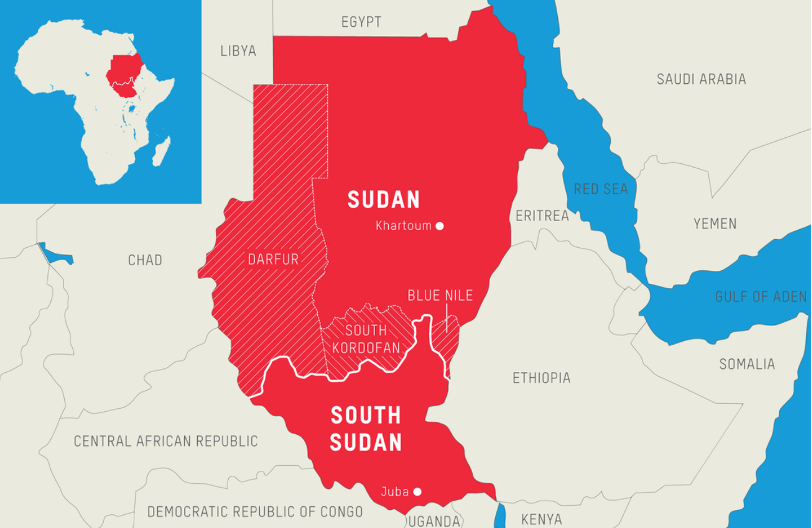
Sudan: Centre and Periphery Grievances
South Sudan Independence
In 2011, South Sudan, which possesses significant oil reserves, gained independence from Sudan. The SPLA transitioned into the South Sudanese army and the SPLM became an official political party and the ruling party of its first (and still current) President Salva Kiir.
New states are indeed hard to rule. Machiavelli was prescient.
A couple of years after its 2011 independence, a political crisis led to the fracture of South Sudan and a descent into its own civil war from 2013-2018, causing displacement, atrocities, and famine, eventually culminating in a power sharing agreement between President Salva Kiir and Vice-President Riek Machar, in the interim to elections. They have yet to take place. South Sudan’s revenue dependence on oil - and access to Sudan’s ports, fragile institutions, and displacements from Sudan have further weakened the new state. Earlier this year, South Sudan’s conflict re-ignited following Kiir’s detaining of Machar and his prosecution for treason, re-awakening the ethnic divides of the civil war which pitted the Dinka-dominated government forces of Kiir against predominately ethnic Nuer rebels. Today, the situation is compounded by Kiir’s attempts to sideline Machar and ensure his own succession through shifting alliances and nepotism. Sudan’s attempted capture of South Sudan’s Heglig oil fields, and Kiir’s ties to the UAE, highlight the inextricable co-dependence between Sudan and South Sudan, and their proxies.
Meanwhile in Sudan, the loss of South Sudan, and oil revenues, created waves of economic and political protests in 2018-2019 leading to the removal of long-ruling President Omar Bashir by the army and the eventual instauration of a Transitional Sovereignty Council (TSC) to prepare for elections. This interlude of civilian-military rule, led by Prime Minister Abdalla Hamdock, ended in yet another coup in 2021 by General Abdel Fattah al-Burhan, the head of the Sudanese Armed Forces (SAF), in alliance with his deputy, General Mohamed Hamdan Dagalo, known as Hemedti, who leads the Rapid Support Forces (RSF). The RSF is a paramilitary force legally formed in 2013 and recognized by President Bashir in 2017 as a de facto Praetorian guard, linked to the government’s military and intelligence apparatus but under the direct command of the President. However, Burhan and Hemedti’s alliance unravelled in 2023 when Burhan pushed for the integration of the RSF as part of the national army.
Sudan’s Proxy War: Saudi Arabia and the Central Role of the UAE
By April 2023, the two factions, namely, Burhan’s SAF and Hemedti’s RSF, were fighting for territorial control with the support of foreign funding, weapons, and training, allowing them to battle, extend, or escalate a conflict while avoiding direct confrontation. Whilst many states are involved in Sudan’s fracturing, Saudi Arabia, and the UAE, both relatively late supporters to Bashir’s regime, initially aligned to counter Qatar, Turkey, and Iran’s support for Islamists, are now in an indirect confrontation through their respective support to the SAF and the RSF. This is indeed the definition of a proxy war, although Riyadh claims neutrality and Abu Dhabi denies backing the RSF. But what are these groups and their leaders seeking?
The Islamist Legacy and the Sudanese Armed Forces (SAF)
SAF’s leader, Burhan, is a military leader who aims to consolidate power. Burhan’s core goals are to preserve the Sudanese Armed Forces (SAF), integrate the RSF within the national army, maintain his own legitimacy as interlocutor to oversee any transition to peace, to a new political configuration, and stifle any civilian empowerment efforts. Domestically, Burhan incarnates the old Arab-Islamic Khartoum based-elite. He builds on his network with Islamists such as the Muslim Brotherhood, who were central to Omar Al-Bashir’s regime. Externally, he is supported by Saudi Arabia and Egypt who fear Islamist ideology but see Burhan, perhaps paradoxically, as a bulwark against the potential spillover of Islamist ideology in the region. Iran provides drones and other military equipment to Burhan, and Eritrea ensures security cooperation along its borders.
Arab Supremacy and the Rapid Support Forces (RSF)
Hemedti’s core goals are to preserve the independence of the RSF, and its strength as a military and economic agent who uses gold, cross-border networks, and patrons to maintain his dominance. In contrast to Burhan who represents the old Khartoum elite, his discourse centres on representing the voice of marginalized Arabs. The RSF grew out of the Janjaweed, Arab militias mobilised in Darfur and still led by Arab Darfurians, responsible for the ethnic cleansing and atrocities committed against non-Arab communities such as the Fur, Masalit, and Zaghawa, in Darfur in 2003. Although under Bashir, Hemedti was aligned with his Islamist ideology, he is now opportunistically positioned again Islamists. He is supported by the UAE and Russia-backed groups. He also benefits from supply routes from Chad, Libya, South Sudan, Ethiopia, and Somaliland airstrips, mostly through the UAE’s tentacular alliances. In short, Hemedti is a political entrepreneur and wealthy businessman running a paramilitary group.
Homo sapiens is inherently good at storytelling, Harari reminds us.
The RSF story is grounded in a narrative around state capture, since independence, by soldiers, traders, and Islamists who enrich themselves to the detriment of the majority. In this RSF story line, Burhan, the SAF leader, is framed as part of a long-standing kleptocratic elite continuing the Islamist legacy and profiteering mindset of Omar al-Bashir. In contrast, RSF positions itself as a liberator - notwithstanding RSF’s plundering of ordinary citizens.
In October 2025, following 18-months of siege, the massacre of Al Fasher momentarily captured world attention. Sudan effectively fractured in two. The RSF formed a rival government to the SAF, although its authority is not established. In Al Fasher - and Sinja, Khartoum, Nyala, Wad Madani, RSF fighters plundered, mutilated, murdered, and raped systematically, leaving evidence of ‘siege-induced famine’ and ‘hallmarks of genocide’ in their stated pursuit to eliminate non-Arab communities. The number of people killed in the conflict cannot be ascertained but estimates vary between 20,000 and 150,000 fatalities. Nearly twelve million people have been forcibly displaced according to UNHCR. The RSF’s capture of El Fasher consolidated the paramilitary group’s control over the entire Darfur region.
Whilst the UAE supported the SAF in prior years, and continues to do so, it is currently widely recognized as the main backer of the RSF and Hemedti. Saudi Arabia aligns with the SAF – who engages in indiscriminate bombing, torture and uses starvation as a weapon of war. Saudi Arabia, the closest to Sudan, is particularly interested in stability and territorial integrity. Sudan already has long-standing disputes with its neighbours: with Ethiopia over the fertile land of Al Fashqa triangle; with Egypt over the mineral resource-rich Halaib triangle; and with South Sudan over the oil-rich Abyei area. On the Red Sea side, Sudan’s war may cause a shrinking of trade volume passing through the Suez Canal, thereby raising international tensions over this vital waterway.
What does the case study of Sudan teach us about Saudi Arabia and the UAE’s evolving foreign policies?
Saudi Arabia and the UAE: From Allies to Rivals in the Horn?
To understand the stakes around hegemony and influence around the Arabian Peninsula, the Red Sea and the Horn, one needs to visualize the geography of strategic interests. The Horn of Africa, resembling a rhinoceros horn, encompasses Djibouti, Ethiopia, Eritrea, Somalia, Somaliland, and, for some, Sudan and Kenya. In addition to its proximity to the Arabian Peninsula, what makes the Horn geo-strategically infatuating is its access to the Red Sea and the Strait of Bab-al-Mandab, the Gate of Tears - infamous for its unpredictable navigation conditions.
As can be observed in the map below, Bab-al-Mandab connects the Mediterranean and Suez Canal to the Red Sea, the Gulf of Aden, Arabian Sea, and the Indian Ocean. It enables the passage of 8.6 million barrels of oil and other petroleum products per day, making it the 4th biggest ‘oil choking point’ in the world - after the Strait of Malacca, Hormuz, and the Suez Canal/SUMED pipeline.
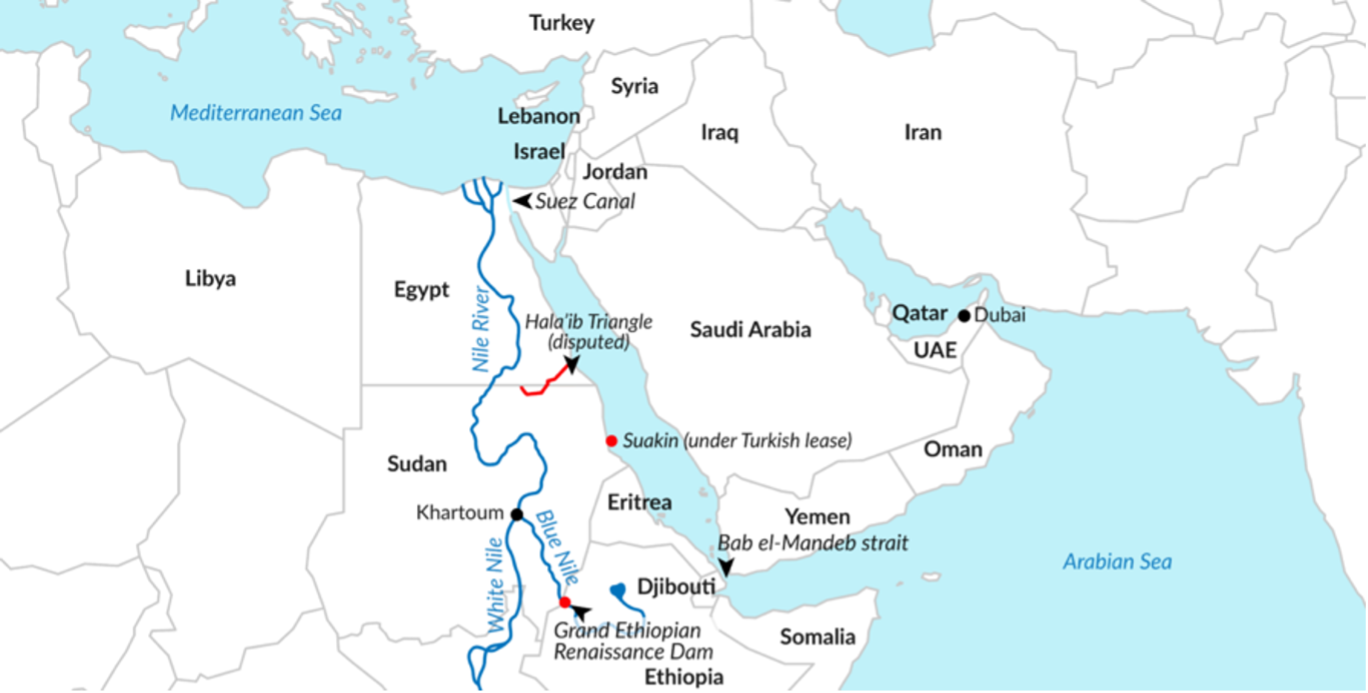
The Gulf and the Greater Horn of Africa
Djibouti, whose President Ismaïl Omar Guelleh, known as IOG, has made port infrastructure and foreign military base hosting a key component of its development and revenue strategy, hosts military bases from the US, France, China, Japan, Italy and others. The UAE, whose Dubai Ports’ license was revoked by Djibouti in 2018, has a presence in several ports on the island of Socotra, in southern Yemen, and neighbouring countries, whilst Turkey has signed a 99-year lease to develop the Sudanese port of Suakin. Israel also sees the Red Sea as a national security priority given past arms transfers from Iran to Hamas via Sudan and Houthi attacks on Red Sea ships in response to the Gaza invasion. In short, Bab-al-Mandab and its vicinity is a hot strategic zone, beyond Gulf countries, because of its access to the Red Sea, Bab-al-Mandab, oil, and naval bases. But how does a geo-strategic interest translate into foreign policy? What are the building blocks of MBS’ and MBZ’s visions?
Principles and Drivers of Foreign Policy in Saudi Arabia and the UAE
In Vision 2030, the over-arching document guiding Saudi Arabia’s vision of a ‘vibrant society’, ‘thriving economy’ and ‘an ambitious nation’, Saudi brands itself as:
The heart of the Arab and Islamic worlds, the investment powerhouse, and the hub connecting three continents.
Saudi Arabia deploys a vision-centred foreign policy with a focus on diversification, investment, and economic transformation. It prioritizes security of both territory and trade routes, including maritime trade routes around the Gulf and the Red Sea. Its current diplomatic paradigm is centred on ‘strategic multi-alignment’ and diversified partnerships. In an increasingly multipolar world beset with geopolitical tensions, and a questioning of Western hegemony, Saudi aims to maintain a balance in its relationships with major powers like the US, China, Russia and to a lesser extent Europe. Operationally, and in recent years, in lieu of high-risk interventionism, it has favoured de-escalation with neighbours such as Yemen and Iran, through a China-brokered agreement. Particularly when its ambitious development agenda is threatened, it has invested in conflict prevention and management in Lebanon and Syria. In line with Vision 2030, Saudi has prioritized economic statecraft deploying diversified energy policies, sovereign wealth funds, and pharaonic projects to project a future-ready vision. MBS was inspired by the UAE’s spectacular rise.
In 2021, the year of its 50th anniversary, the UAE released Principles of the 50: The UAE’s 10 Principles for the next 50 Years. Building on the first two principles of ‘strengthening the union’ and ‘building the best and most dynamic economy in the world’, this document lays out the third principle on foreign policy:
The UAE’s foreign policy is a tool that aims to serve the higher national goals, the most important of which is the UAE’s economic interests. The goal of our political approach is to serve the economy. And the goal of the economy is to provide the best quality of life for the people of the UAE.
Crown Prince since 2004, Mohammed Bin Zayed (MBZ) became ruler of Abu Dhabi and president of the UAE, on the death of his half-brother in 2022. As early as 2008-9, in exchange for bailing out Dubai in the aftermath of the financial crisis, he secured greater security and foreign policy control.
Theoretically, the UAE’s foreign policy is built on the primacy of economic interests, stability, sovereignty, and a rejection of Islamist ideology – it has an existential fear of extremist ideology and of the Muslim Brotherhood, in particular. The UAE’s foreign policy builds on its economic and soft power projection. It promotes a vision of tolerance and openness as an international hub, a global marketplace and a future-oriented development model which builds and manages relationships with Western, Asian, African and other allies. Its foreign policy is non-aligned, or rather, multi-aligned.
The UAE has made a selective use of hard power by proxy, such as in Yemen, Sudan, and the Horn of Africa.
Operationally, it maintains an impressive strategic presence to secure the Red Sea / Bab al-Mandab sea routes. Through Dubai Ports World (DP World), it established a military-logistical footprint in several bases in Eritrea, Somaliland/Puntland, Socotra and Perim in Yemen. After losing a commercial deal in ports management in Djibouti it invested heavily in Berbera in Somaliland, and secured port rights in Mukalla and Aden to secure a maritime presence and lucrative commercial deals. In Yemen, Sudan, Somalia, Somaliland, Ethiopia and Eritrea, it makes use of local allies and proxies to shape domestic balances of power and serve its greater interest in stability and economic rewards.
Although aligned, foreign-policy choices in Saudi and the UAE are distinct, and increasingly divergent.
At a higher level, there is much resonance between Saudi and UAE foreign policymaking: both are framed around regime security, economic transformation, and regional stability, and are driven by pragmatism, and multi-alignment. But their policies are evolving: the UAE leans more on activist, networked, small‑power diplomacy, while Saudi Arabia seeks institutionalised diplomacy, increasingly aligning its foreign policy with Vision 2030 and its role as an emerging major power, a regional hegemon, and a leader of the Arab and Islamic world. Finally, both the UAE and Saudi Arabia, alongside Egypt and the US, are part of ‘the Quad’, and involved in Sudan’s peace process as engaged actors of the conflict.
Saudi Arabia has unique comparative advantages over the UAE: its dominance over the Arabian Peninsula and access to the Red Sea; its singular religious convenor role for some 2 billion Muslims as a Custodian of the two holy mosques of Islam, Mecca and Madina; and its geological fortune given the magnitude of its oil reserves – after Venezuela, Saudi ranks 2nd in oil production and reserves, the UAE, 6th. Although Saudi Arabia’s narrative as an investment powerhouse and global hub rivals that of the UAE, it also maintains a distinct advantage of territorial and population size – some 36 million compared to the UAE’s 11 million - although it lacks the UAE’s cultural openness and attractiveness to access global human capital.
Once tightly aligned with Saudi on the necessity to contain Islamist movements and states such as Iran, Turkey, and Qatar, and maintain stability by supporting stable regimes rather than risking democratic transitions and civilian experiments, today, the UAE is actively engaging in a strategic competition for regional and economic primacy. According to an April 2024 World Economic Forum memo, over the past decade, the UAE has poured $59 billion into Africa, making it the continent’s fourth largest foreign direct investor (nearly catching up with China, the EU, and the United States), while Saudi Arabia has invested $26 billion - many of these investments are concentrated in the Horn.
As the map of the Horn of Africa below illustrates, the omnipresence of the UAE supersedes a Saudi presence in all the Horn – with the exception of Djibouti and Burundi, and across all sectors: infrastructure, financial, energy, mining, ports, agriculture, and security. The Red Sea and the Horn is key to UAE’s African strategy. The UAE is focused on an investment strategy centred on Red Sea ports, agricultural land, livestock, and supply chain routes. Working with militias may be a cost-effective way, at least in the short-term, to negotiate and secure access to key lands, minerals, and ports.

Gulf State’s Engagement in the Horn of Africa
Source: Centre for African Strategic Studies (2025)
Some refer to the UAE’s foreign policy in the Horn as ‘suitcase diplomacy’, which signals a sense of transactional urgency and necessity. Indeed, the UAE imports some 90% of its food in the context of a rapidly growing population – around 90% foreign. Confronted with its vulnerability through global crises - the financial crisis of 2008, the pandemic of 2020, and the Russian invasion of Ukraine in 2022 - it has aggressively pursued investments in agricultural lands. Many of these investments are led by firms and sovereign funds, such as International Holding Company (IHC), Abu Dhabi’s largest publicly listed company, chaired by Sheikh Tahnoon Bin Zayed, a brother of the UAE’s president.
The Pattern of Divergence and Intertwined Proxy Wars: From Yemen, Sudan, Libya, to Somaliland
On 30 December 2025, Saudi Arabia bombed the port city of Mukallah in Yemen targeting two ships from the UAE which delivered weapons and combat vehicles to the Southern Transitional Council (STC), a separatist force. Saudi Arabia urged the UAE to leave Yemen. This UAE interference fragments Saudi’s focus on combatting the Iran-backed Houthis in the north, weakens the central government supported by Saudi, creating further instability on Saudi Arabia’s borders.
The Yemen incident is also linked to Sudan, where Saudi and the UAE continue to be engaged in a proxy war. MBZ, formerly allied with Saudi in Yemen, is said to have a protégé relationship with Hemedti (the leader of the RSF provided mercenaries to fight the Houthis in Yemen, supporting the aim of restoring the deposed government after the Houthis’ capture of Sanaa in 2015). As the war dragged on the Saudis were prepared to agree to a truce, but the Emiratis chose a different course. Driven by an interest in ports, naval facilities, and commercial arrangements, the UAE sided with the separatist STC. The STC, in turn, broke its alliance with the recognized government, supported by Saudi, thus ushering in a new round of conflict. Saudi accused the UAE of ‘undermining its national security’ and ended its defense pact with the UAE.
Sudan is also linked to Libya. The RSF also provides the UAE with mercenaries to fight in Libya in support of General Haftar against the Tripoli government. In turn, Libya offers a corridor to the UAE to channel military equipment and foreign mercenaries to the RSF. The UAE also recruits fighters from improbable lands such as Venezuela and Colombia. In December 2024, Colombian president Gustavo Preto reported that hundreds of Colombians had been duped into fighting in Sudan by a UAE-based private security company.
In Sudan itself, the UAE benefits from a perfect product-market fit for Sudan’s conflict gold. It provides Hemedti with a financial, logistical and re-investment supply chain through Dubai. Hemedti’s numerous registered companies in Dubai control goldmines in Darfur. The gold is essentially looted from Darfur and sold almost entirely in the UAE. Some 60% of proceeds are re-invested in the UAE, notably, in real estate. In a 2022 report, the UN estimated that over 400 tons of Sudanese gold transiting through Chad, Egypt, South Sudan, Uganda eventually end up in the UAE.
Gold from SAF-controlled areas is also almost entirely sold in Dubai. The Central Bank of Sudan reported that in 2024 almost 97% of official gold exports from SAF-held areas were directed to the UAE, generating almost half of Sudan’s declared export earnings that year. Notably, the Bank of Khartoum, on which the Port Sudan authorities rely for its export and import activities, and which hosts Bankak, the most popular mobile money app in Sudan, is partly owned by the Dubai Islamic Bank. The UAE is multi-aligned, pragmatic, and commercial in its foreign policy deals.
On 26 December 2025, the stakes in the Horn of Africa were raised when Israel recognized Somaliland as an independent country from Somalia – the only country in the world to do so. It intensified the rivalry between the UAE on one side, which brokered the Israeli-Somaliland deal and supports it, and Egypt, Saudi Arabia, and Turkey on the other, who oppose it. None of the many regional players want to see a rival, let alone an enemy, accessing control over this strategic waterway, as the map below illustrates.
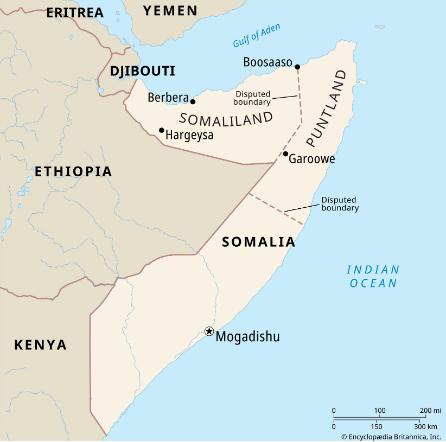
Somaliland: Recognized by a Single Country
The UAE’s foreign policy has therefore taken a very distinct path in the last few years, one that openly rivals Saudi’s influence and is primarily driven by commercial interest, in alignment with its stated principles. In turn, to counter the UAE’s growing influence in the Horn, through the RSF and its ties to Israel, Saudi has designed and operationalized a ‘new Red Sea axis’ including Turkey, Egypt, Djibouti, Eritrea, Somalia, building on its alliance with Sudan’s SAF. It has, for instance, secured defense agreements with Eritrea and Somalia, including a port investment in Laqsooray, as a counterweight to the UAE’s Berbera presence in Somaliland - whose port is also partly owned by the UK’s investment arm.
Given their Divergence in Sudan and the Horn: How will 2/28 Impact the Saudi-UAE Relationship?
On 28 February 2026, Israel and the US launched an illegal attack on Iran, violating the UN’s Charter on the use of force and the principles of territorial integrity and sovereignty. As in the surprise attacks of the 12-day war of June 2025, these joint attacks were carried out amid negotiations between the US and Iran. Mediated by Oman, all parties confirmed they were advancing towards a resolution around nuclear enrichment. Yet, on 2/28, a Saturday morning of the month of Ramadan, one of the US’ missiles first target were 168 civilians, the majority of which were children in school, in Minab.
The Gulf Cooperation Council (GCC), which had condemned Israeli attacks on Iran in June 2025, did not react this time. The emergent intelligence confirms that this was not a justified attack on self-defense grounds and that US President Trump’s decision to attack Iran was led by Israel.
This time, Iran was prepared and swiftly retaliated by targeting US bases in the region, and their host countries. At its extraordinary Ministerial Gulf Cooperation Council meeting on the 1st of March 2026, the Council condemned the Iranian missile and drone attacks against the UAE, Bahrain, Saudi Arabia, Oman, Qatar and Kuwait, describing them as “treacherous”.
Prior to these attacks, Gulf states were pursuing diplomatic avenues to dissuade the US from attacking Iran, including by engaging with mediation efforts. The risks to the Gulf were known to be very high.
In the last decade, Saudi Arabia has been notoriously ambivalent on Iran. On the one hand, like the UAE, Saudi favours stability and economic interests to execute on Vision 2030. On the other hand, MBS has been distrustful of Iran’s revolutionary leadership and its power as a potential competitor regional hegemon.
Saudi and the UAE diverged on two fronts around Gulf diplomacy.
First, in 2020, the UAE and Bahrain, later joined by Morocco and Sudan, signed the Abraham Accords, a series of normalization agreements with Israel centred on diplomatic, security, economic, and scientific interests. Saudi Arabia did not join the Accords given its wider role in the Arab and Islamic world, its concern for Gaza and Palestinian statehood, and public opinion.
Instead in 2023, Saudi Arabia engaged in a rapprochement with Iran, brokered by China. Challenging the premise of the Abraham Accords, that is, to build an alliance to contain Iran, Saudi Arabia imagined an enlarged vision for peace and prosperity in the Gulf, of a new Middle East. Today, this vision seems like a mirage.
Second, as a result of the US-Israeli attacks on Iran, all six GCC countries were hit back in retaliation, for hosting US bases, although the UAE was particularly singled out given its alliance with Israel sealed by the Abraham Accords. The UAE responded by closing its Embassy in Tehran and recalling its ambassador, whilst the five other Gulf states have exercised restrained, thus far, possibly to reactivate diplomatic channels towards a cease-fire, and a peace process. The UAE’s alliance with Israel, in the Gulf, and in the Horn, particularly in Somaliland, may have, paradoxically, undermined its own national security – and that of GCC states.
Rethinking Security Umbrellas: Testing Saudi Arabia’s ‘Islamic’ Leadership
Saudi Arabia learnt that the joint Israel-US attacks on Iran in June 2025, and again in February 2026, undermined its own national security, leaving GCC countries vulnerable to both Israeli attacks and/or to Iranian retaliatory attacks by their affiliation to the US. But for Saudi Arabia, the de facto regional hegemon, and self-proclaimed leader of the Islamic world, this has wider security implications.
This is precisely why MBS reached out to Islamabad in the fall of 2025 to seek a new security umbrella, including nuclear protection. On 17 September 2025, Saudi Arabia and Pakistan signed a Strategic Mutual Defence Agreement (SMDA), which covers defence industry collaboration, technology transfer, military co-production, training and capacity-building. Saudi’s generous financial support of Pakistan’s nuclear development and testing is not new. Some 30 years ago, under the intense scrutiny of Israel, Abdul Qadeer Khan, the architect of Pakistan’s nuclear program, was training Iran and Libya, as Pakistan developed an ‘Islamic bomb’ – becoming the only majority Muslim country with nuclear deterrence capability. This agreement is a signal that something feels wrong in the current Gulf architecture, a feeling that is echoed by many.
On March 16, 2026, a day before his death in an Israeli missile strike, Ali Larijani - the Head of Iran’s Supreme National Council accused Gulf countries of abandoning Iran. He singled out the UAE for describing Iran as an enemy as it legitimately defending itself against unlawful US and Israeli attacks. In some of his last words, he asked: ‘Is the position of some Islamic countries not in contradiction with the words of the Prophet? Whoever hears the cry for help of a Muslim and does not respond is not a Muslim? So what kind of Islam is this? […] Which side of this battle do you stand on?’
Beyond religion or ideology, Saudi Arabia and the UAE’s foreign policy principles share a common feature: the absence of any ethical consideration – not unlike many ‘pragmatic’ or duplicitous governments.
Can any Foreign Policy Succeed without a Moral Compass?
Moral framing is a collective good, a positive externality to be enjoyed by all states. When it is absent, all pay the price, eventually, as no system remains in place to enforce any ‘red lines’. The banalization of genocides from Gaza to Sudan, the normalization of transgressions to international law, the creation of a ‘Board of Peace’ by an invasion-inclined President suggests that we may be in Orwellian territory.
Joseph Nye argued that good moral reasoning in foreign policy ‘should be three-dimensional, weighing and balancing intentions, consequences, and means.’ On the question of consequences, he suggested considering an institutional order that encourages moral interests alongside considerations on the costs of non-action. While the world reckons with what seems like a reset of global norms, shifting foreign policies, and erratic tweet-diplomacy, Nye’s framework may be the right one to re-assess the Abraham Accords, defense agreements, security dependencies, and foreign policy decisions and statements.
From the Gulf to the Red Sea, and Sudan to the Horn of Africa, Saudi Arabia and the UAE’s foreign policies’ have become increasingly divergent in the last few years. Their dangerous proxy wars continue to fuel insecurity in their overlapping spheres of influence and/or commercial interests. Perhaps, it is the moral agnosticism of their foreign policies - by no means unique in our global context, that stands out as worrying amid genocides in their own region. The US-Israeli attacks on 2/28, our collective failure to rethink the paradigm of nuclear deterrence, could, unexpectedly, provide an opportunity for re-imagining the security architecture of the Gulf. Could this be Saudi Arabia’s moment to assume moral leadership?
Instead, it appears that MBS, possibly in alignment with other GCC countries, may now be counter-intuitively persuading the US to finish what they started in Iran, despite the continuing unfolding of the predictable matrix of risks set in motion by the US-Israeli attacks. As of today, the Pentagon has ordered 2,000 U.S. Army Paratroopers to standby in the Middle East, bringing the number of additional ground troops to 7,000. Globally, some 50,000 US troops have been mobilized around Operation Epic Fury, which deserves its name. Attacks on vital civil infrastructure in Iran, a ground invasion, and the use of nuclear weapons (by the US and Israel) cannot be excluded. Beyond transactional state interests and alliances, and disconcerting leadership pathologies on display, who will rise to uphold the international legal and moral order?