
Iran in 2026: The End of the Islamic Revolutionary Regime?
02 February 2026
Farahnaz Karim
In his opus magnum War and Peace (1869), set during the Napoleonic Wars of 1805 and 1812, Tolstoy distills his own view of history weaving meticulous historical research with the intricate portrayal of four aristocratic families - the Bezukhovs, Rostovs, Bolkonskys, and Kuragins. He asserts that whilst leaders are often perceived as shapers of history, they are, often unknowingly, steered by a myriad of arbitrary people and events and structurally propelled by a greater historical movement.
Tolstoy’s view of history still resonates today. It interrogates us: is the greater historical movement we are part of a ‘de-centering of the West’ in favor of a multipolar world? Are we witnessing the battle for the preservation of Western hegemony?
This question is fundamental to shed light on the fate of Iran’s Revolutionary Islamic regime.
The Cycle of Contestation, Repression, and Structural Control
In 2009 (Presidential Election Protests), 2016 (Cyrus the Great Revolt), 2022 (Woman, Life, Freedom Movement), 2025 (Water Crisis Protests) and 2026 (Economy-Regime Change Protests), many predicted the imminent end of Iran’s revolutionary regime.
This time feels different; but then again, each time felt different.
As of today, some 3,000-6,000 protestors are estimated to have been killed, tens of thousands arrested, and thousands maimed – their organs deliberately targeted to ensure a shameful and perennial life of disability. What started out on 28 December 2025 as a popular protest in reaction to the shocking dip in the value of the Iranian rial crippling Iranians’ purchasing power for basic goods, turned into nation-wide, concerted, anti-regime contestations punctuated by ‘death to the dictator’, a reference to the Iranian supreme leader, 86-year-old Ayatollah Ali Khameini.
In retaliation, state-ordered violence has been reinforced by a digital blockade. Iranians have been cut off from the internet and mobile access for weeks. The system of (dis-)information is at work: the regime blames external agents, ‘terrorists’, and responds with ‘official’ aerial footage of massive pro-government manifestations. Imam Khameini’s website reminds its people, and the world, that the real enemy is foreign – a view that some Iranians share.
Learning from the weakness of the Shah’s rule, the revolutionary regime’s intransigent repression playbook is all-too familiar – counter-protests, repression, reinforced structural control, evaluation of lessons learned - but what is perhaps less understood is the unique make-up of the state apparatus of Iran. Iran, unlike Chile, Guatemala, Indonesia, Congo, and more recently, Venezuela, Iraq, Libya, Syria, Afghanistan, is not a typical regime-change candidate.
First, Iran is a theocracy.
Iran’s post-1979 Constitution entitled Governance of the Jurist: Islamic Government (vilāyat-i faqīh: hukomat-i Islāmī), which is to ‘remain in force until the return of the Mahdi’, states that the current Imam governs in lieu of the Mahdi – a reference to the Twelver Shia Muslims’ belief that the 12th Imam, Muhammad al-Mahdi, is in occultation and will return to rule and establish justice on earth. This notion, presented as a variant of a messianic vision shared by other Abrahamic faiths, is taught to children in school textbooks at an early age. In short, the current Imam is filling the leadership gap in Imam Al-Mahdi’s absence (dating back to 874 CE). In this interim, the Imam’s divine guidance enables the pursuit of justice on earth, which includes rejecting colonialism, imperialism, and monarchical rule. Iran’s revolutionary worldview and narrative blends Shia theology with an anti-imperialist international relations discourse in favour of the oppressed - a unique ideological offering.
Second, the revolutionary regime’s power is both concentrated and diffused, much like an octopus.
Everything leads to and derives from the Supreme Leader, the Imam, appointed on the merit of his Islamic scholarship mastery. Imam Khameini’s power is indeed supreme: he has conceptual and final authority on nuclear and foreign policy, and rules over his own army.
Whilst Iran has a conventional army, since the 1979 Revolution led by Imam Khomeini, and prompted by the Iran-Iraq war, it has developed its own paramilitary army, the Islamic Revolutionary Guard Corps (IRGC), also known as the Pasdaran (the Guardians), armed with an operational capacity to conduct extraterritorial missions through the Quds force. In addition to substantial ground, navy, and aerospace forces, the IRGC also oversees a 600,000-strong volunteer paramilitary force known as the Basij – a civilian-run tentacular moral policing, indoctrination, surveillance, and security apparatus permeating mosques, schools, universities and government offices.
The IRGC also controls the Iranian economy. Charged with rebuilding infrastructure destroyed in the Iran-Iraq War (1980-88), today, the IRGC controls prominent sectors including oil, banking, manufacturing, shipping and consumer imports through no-bid contracts. These economic activities provide the financing for the IRGC’s activities and priorities from support to martyrs and nuclear development to regional missions. US and Western sanctions have paradoxically strengthened the IRGC’s revenues through black-market deals with non-Western powers.
Whilst Iranians elect their President and members of Parliament, all candidates are vetted or filtered by the Guardian Council, under the control of the Supreme Leader. In essence, the President has a representational role, albeit a significant one, but is overshadowed by other centres of power. To many foreigners, current President Pezeshkian is perhaps less known than top General Qasem Soleimani, head of the Al-Quds force, assassinated by the US in Iraq in 2020, and mourned by millions as a martyr.
Third, seeking a re-ordering of the world order, the Islamic Revolution in Iran is inherently designed for export.
A revolution thrives on diffusion. As part of a strategy of ‘forward defence’ and building an axis of resistance, Iran’s state apparatus is deployed to back Shia militias and/or Western-antagonistic groups in the region in Bahrain, Iraq, Lebanon, the Palestinian Territories, Syria, and Yemen. An estimated 200,000-strong force supports militias such as Al-Ashtar Brigades, Hezbollah, Hamas, the Houthis. Over half of the force is focused on Iraq and Syria alone operationalizing various brigades such as the Badr Corps and the Popular Mobilization Forces (PMF) in Iraq, and the Fatemiyoun Brigade in Syria.
Iran’s Regional Axis of Resistance
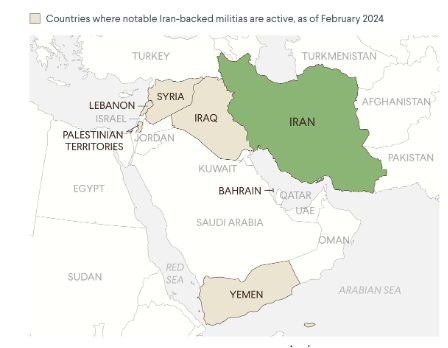
The Hamas’ 7 October 2023 attack on Israel, and the Israeli government’s retaliation towards Iran and its allied groups – some of which had launched missile attacks on Israel in support of Gaza – has undoubtedly weakened Iran’s axis of resistance. Surgical Israeli attacks on Hezbollah and its leader Hassan Nasrallah, the decimation of Hamas leadership, and collapse of Bashar Al-Assad’s regime, an ally of Iran, have also recalibrated Iran’s influence in and around Syria.
Despite this weakening of allied groups, many point to the resilience of Iran’s influence through proxies such as the PMF, Hezbollah, and the Houthis, given their economic clout and authority as part of existing state and societal structures, and their transnational connectivity in terms of trade and supply chains across formal and informal economic networks. However, Israel’s direct surprise attacks on Iran on 13 June 2025, and by the US, on 21 June 2025, both aimed at damaging Israel’s nuclear facilities, demonstrated Iran’s vulnerability, on its own territory. Despite causing less damage than anticipated, the US hit three of Iran’s atomic centers with B-2 bombers commonly known as ‘bunker-busters’.
In sum, the blow to Iran’s axis of resistance in the last couple of years, recurrent domestic protests, and Israeli and American attacks on Iranian territory, have further tested Iran’s resilience which continues to rest on its theocratic legitimacy, powerful tentacular state apparatus, and entrenched regional proxies. More broadly, the regime’s anti-West, anti-imperialist stance continues to appeal in a region, and arguably, a world where the West’s primacy is contested, if not fractured.
Regime Change Anyone?
Within the parametres of these unique attributes – ideological, structural, and operational – a change of regime in Iran, through external interference or internal pressure, remains possible but constrained by the robust revolutionary architecture entrenched over the last 47 years. Western leaders and institutions invoke human rights in favor of protesters, sporadically slap more sanctions on Iran and its leadership, and some vehemently threaten military action against Iran, but is regime change really in anyone’s interest?
On the domestic front, the collective will is tainted by historical memory and a lingering distrust of the West.
Roughly four in ten people are under the age of 25 in Iran’s 93 million population - by far the most populated country in the Middle East. This is a vibrant pool of human capital connected to a globalized world. When not blocked, more than half of Iran’s population is active on social media. Together with the ‘bazaar’, the merchant class, these students and youth possibly share grievances around the imposed hijab - the anachronistic symbol of the revolution, environmental degradation, economic mismanagement, endemic corruption, and costly foreign policy forays in Arab countries which have not materially improved Iranians’ standard of living.
It is, however, useful to remember that the same segments of society protesting today - the bazaar and students - were also at the forefront of the Islamic Revolution in 1979, chanting anti-Western slogans. The protests then were aimed at the Shah, Mohamed Reza Pahlavi, deemed autocratic, decadent, and Western-friendly. The popular uprising eventually led to a change of regime from the Pahlavi dynasty’s constitutional monarchy to a theocracy. After Ayatollah Khomeini’s triumphant return in 1979, a referendum in favor of the revolution boasted a 98% approval rate. Leaving little ambiguity, a second referendum on the Islamic constitution was supported by 99% of voters.
But Iranians’ ambivalence towards the West pre-dates the Shah’s regime. The roots of distrust towards the West can be traced back to the coup, anchored to this day in the vast collective memory of Iranians, and Western officials. In 1953, the Central Intelligence Agency (CIA), together with MI6, the British Secret Intelligence Service, overthrew the democratic regime of Muhammad Mossadeq to lay the groundwork for the monarchical rule of the Shah. The coup d’état, which came two years after Mossadeq’s nationalization,was the result of a failed attempt at negotiating the terms of control of the oil industry, from exploration to exportation. State sovereignty was Mossadeq’s driver, whilst Western control of oil supplies and profits motivated the Anglo-Iranian Oil Company - later known as British Petroleum. The US concern was that a nationalization of oil in Iran would inspire others, Saudi Arabia, Kuwait, and Venezuela, threatening US interests and global stability.
Iranians’ ambivalence towards the West is fuelled to this day by examples of injustice. In 2015, European-led talks on Iran’s nuclear enrichment program eventually led to a US and UN-approved deal, the Joint Comprehensive Plan of Action (JCPOA), which traded strict limits on enrichment for sanctions relief. In 2018, during his first term, President Trump exited from the deal unilaterally despite Iran’s compliance at the time as part of a policy of ‘maximum pressure’ on Iran. This is precisely when Iran began to exceed the limits set on enriched uranium – moving from 3.67% to some 60% today, below the 90% required for weapons-grade. The JCPOA had an embedded ‘snapback’ mechanism allowing signatories to unilaterally reimpose UN sanctions on Iran in case of non-compliance. By October 2025, Britain, France, and Germany (E3), backed by a vote of the UN Security Council, activated the snapback mechanism in response to Iran’s failure to meet its obligations to the International Atomic Energy Agency (IAEA). However, the issue of Israel and U.S. military strikes on Iran’s nuclear facilities in June 2025 was left un-addressed by the IAEA. Iranians were reminded that multilateral regimes are subjected to US unilateral volatility and are biased towards the West and its allies.
In practice, sanctions impose limits and conditions on oil exports, decrease Iran’s revenue base, cause a devaluation of the currency, an increase in the cost of living and a decrease in the purchasing power of Iranians, possibly elevating the risk of popular unrest. In short, the relationship between an agreement on the nuclear front in exchange for sanctions’ relief is a pre-condition to prevent a worsening of the economic situation for the majority.
In short, through collective memory and contemporary history, Iranians understand regime change, and its perils. It is unlikely that Western interference, particularly through devastating sanctions, repeated military threats or attacks, and an enduring manifest interest in oil, would appeal to the majority of Iranians. It may in fact revive their unity through ideological alignment with the leadership, their patriotism being anchored in a deep-rooted civilizational awareness.
On the regional front, balance of power, security and stability define national interests.
Balance of power is meant to prevent the emergence of a hegemon. The Islamic Revolution of 1979, resting on Shia theology, and subsequent Iran-Iraq war (1980-1988) and Gulf wars highlighted Western interests in calibrating not only military and economic power in the Middle East, but also in managing a sectarian balance of power. Although Shia Muslims represent roughly 15% of some 2 billion Muslims in the world, they constitute around half the population of the Middle East and the majority of the populations of Iran, Iraq, and Bahrain. Covert support to Iran, and its proxies, has, in many instances, been useful to contain radical Sunni groups threatening the security of the region.
Moreover, Gulf monarchies have an interest in a stable Iran. Regime change through foreign interference or internal mass protests might set a precedent in their own countries, reviving fears of the Arab Spring. Given the importance of US military bases in the Gulf, notably in Qatar or Bahrain, a military build-up and/or attacks may also threaten or violate their own sovereignty through possible retaliation, destruction of oil and gas infrastructure, or mass displacements.
Finally, the risk of military escalation and confrontation near the Strait of Hormuz - a corridor through which roughly a quarter of the world’s oil and gas passes, including a fifth of the world’s LNG from Qatar - may trigger massive global disruptions through naval mines, missile attacks, or a blockade, exacerbating a geopolitical risk premium on the price of oil. These, in turn, could have ripple economic effects particularly in the Gulf where ambitious post-oil development plans are premised on stability and sizeable foreign investments and partnerships. The vision of an enlarged Abraham Accords (2020), the treaty of peace between the UAE, Bahrain and others, with Israel, seems more aligned with Gulf countries’ interests than the unknowns of regime collapse in Iran, and its aftermath.
In sum, balance of power, security, and stability are key drivers of the détente-oriented preferences of Gulf states. From their standpoint, regime change in Iran is a high-risk bet.
On the international front, non-Western countries are incentivized to prefer the status quo in Iran.
After Russia, following its invasion of Ukraine, Iran is the country hit with the largest number of US and Western sanctions in the world - over decades, and more so since President Trump’s first mandate and its policy of ‘maximum pressure’. Ironically, the sanctions have encouraged Iran to form intricate webs of friendships with other pariah states, benefiting a ‘sanction-circumvention’ elite in Iran, and elsewhere, to the detriment of Iranians. Counter-productively, Western sanctions have possibly indirectly benefited regime consolidation through both endemic corruption in Iran and the perceived injustice felt by ordinary Iranians on nuclear negotiations largely driven by Western interests and timelines.
Moreover, hegemonic contenders, Russia and China, and others, are unimpressed by the selectively enforced ‘rules-based order’ imposed by Western countries and institutions and relate to Iran’s anti-imperialist narrative. Their shared worldview centers on moral agnosticism and a refocus on some central premises of the international order: sovereignty and non-interference in domestic affairs.
The last point of convergence is necessity. Given the level of international sanctions, Iran needs alternative markets, just as China needs oil and gas. The latest wave of sanctions may have diminished the number of countries trading with Iran, but ship-to-ship transactions, tracking evasion methods, intermediary financial structures bypassing the dollar economy, and private ‘teapot’ refineries are in place to facilitate oil sales from Iran to Asia.
The clientelist networks, shared worldview with Iran, and trade links help explain why the status quo in Iran benefits international powers, including regional players. Regime-change may be appealing to some in Iran, and to the diaspora, but can be seen as a high-risk option from a historical memory standpoint in Iran, and from a regional and international geopolitical risk standpoint.
Second-order Thinking: And Then What?
In the context of these vested interests in the status quo, what could be the most plausible scenarios ahead?
Succession planning for the 86-year-old Supreme Leader, Ayatollah Khameini, must already be in place to begin phase three of the Revolution.
If not in 2026, certainly in the next few years, subject to health and divine will, the current Supreme Leader will be replaced. By default, a succession plan looks at patrilineage. Ali Khameni’s second son, Mojtaba Khameini, a cleric and politician involved in supervising the Basij, could be seen as a contender. However, under the ideology of the regime, and its constitution, Mojtaba may not meet the high Islamic scholarship credentials required. Moreover, hereditary succession is considered anathema as it contradicts a fundamental tenet of the revolutionary ideology, namely, the difference between a theocracy and a monarchy. On the same grounds, it is equally unlikely that Ayatollah Khomeini’s grandson, Hassan Khomeini, would be a successor. It is, however, probable that a successor has already been selected but his identity is concealed on theological grounds and/or for reasons of security until a formal appointment is made by the Assembly of Experts.
Internal gradual reform without foreign interference is more likely.
Foreign dissident groups lobbying for regime change are not united. Former Crown Prince Reza Pahlavi, son of the deposed Shah, has made a powerful mediatic resurgence framing his possible return and role to support a transition to democracy. His legacy association with the Pahlavi regime can be considered both an asset and a liability. Given his decades-long absence from the reality of Iran and Iranians, and his perceived association with the West and its allies, he is unlikely to gain momentum outside the diaspora elite dreaming of a return, and a return to a bygone era.
In view of all vested interests, a strategic path forward could centre on the gradual inclusion and/or promotion of a cadre of reformists and technocrats, including former Presidents, and conservative pragmatists within the current state apparatus. For those who choose to accept it, this Mission Impossible could prioritize economic and institutional reforms to ‘make Iran even greater’. Amongst many contenders, this may include a role for the speaker of the Parliament of Iran, Mohammed-Bahgher Ghalibaf, and/or the ambitious Ali Ardashir Larijani, a presidential candidate in 2024, who currently serves as the Secretary of the Supreme National Council and as a member of the Supreme Council of the Cultural Revolution.
An internal coup and/or internal fragmentation cannot be excluded.
Finally, a variant of an internal coup d’état by some IRGC commanders cannot be excluded. While the IRGC, a paramilitary arm, was precisely founded to prevent a breach of loyalty to the Supreme Leader, internal dissent is growing after the last wave of protests. Some ask: could brutal violence against one’s own citizens and vibrant youth emanate from divine will? But dissent may also come from hardliners, such as Saeed Jalali, President Pezeshkian’s rival in the last election. A letter signed by 70 members of parliament called for a ‘change in the defence doctrine’ of the regime - after June 2025 attacks on nuclear sites and Iran’s leadership by Israel and the US. They advocate for a nuclear deterrence capacity or a potential withdrawal from the Non-Proliferation Treaty (NPT), both of which are not supported by Ayatollah Khameini.
As Iran faces the imminent prospect of a second wave of attacks from the US, with Israel’s blessing, Iranians are ready to negotiate. Surely President Trump, who sees himself as a Peace Czar, has been briefed on the long history of Western betrayal towards Iran since 1953, which ironically led to the unforeseen 1979 Revolution and to this point in world history. In the struggle for the preservation of the West’s hegemony, in the midst of other powerful contenders, perhaps it is time to pause and listen to alternate worldviews that question the West’s duplicity. A gradual relief of sanctions on Iran and a phased return of the US to the JCPOA process seems most sensible to avoid war, give voice to Iranians sanctioned by sanctions, and maintain global stability. In a sense, the rational way forward depends on the US and its remaining allies in a self-fracturing West. A gradual re-entry of the US into the JCPOA process to ease sanctions for the majority of Iranians would be a first step. The unknown risks of an accelerated Iran glasnost, in favor of the West, as well as the déjà vu triumph of hard-liners cannot be discarded. Most importantly, in this moment of the West’s contestation, the structural movement of history of our time, Tolstoy’s words in War and Peace resonate more than ever on the absurdity of war:
Every reform by violence is to be deprecated, because it does little to correct the evil while men remain as they are, and because wisdom has no need of violence.
Can we, in 2026, begin to learn from our shared history, and act from our shared humanity?